Friday, November 28, 2014

Advent - Sunday November 30,2014


Here are some brief notes for a Advent reflection from Father Raymond Brown
A Coming Christ in Advent    
 
 Cheat Sheets of Notes
 
Saint Matthew account of the genealogy of Jesus contains the
essential theology of the
Old Testament
New Testament
for the whole Church
  • Orthodox
  • roman Catholic
  • Protestant

Brown says Ulrich Zwingli preached it back in the time of the Reformation.
 
It is the idea of Salvation by Grace.
 
The genealogy of Jesus is lopsided
  • Abraham begets Isaac
  • No mention of Ishmael who is a victim here
  • Isaac begets Jacob- not a word about Esau-whom Jacob stole his  birthright.
  • Jacob begets Judah -why is  Judah mentioned and not the good and extraordinary Joseph.
Matthew shows God does not necessarily select the most deserving person.  It is Salvation by Grace.


Thursday, November 27, 2014

Thanksgiving Day 2014 November 27

Thanksgiving image


Thanksgiving Proclamation
Issued by President George Washington on October 3, 1789
By the President of the United States of America, a Proclamation
Whereas it is the duty of all nations to acknowledge the providence of Almighty God, to obey His will, to be grateful for His benefits, and humbly to implore His protection and favor; and-Whereas both Houses of Congress have, by their joint committee, requested me "to recommend to the people of the United States a day of public thanksgiving and prayer, to be observed by acknowledging with grateful hearts the many and signal favors of Almighty God, especially by affording them an opportunity peaceably to establish a form of government for their safety and happiness:"
Now, therefore, I do recommend and assign Thursday, the 26th day of November next, to be devoted by the people of these States to the service of that great and glorious Being who is the beneficent author of all the good that was, that is, or that will be; that we may then all unite in rendering unto Him our sincere and humble thanks for His kind care and protection of the people of this country previous to their becoming a nation; for the signal and manifold mercies and the favor, able interpositions of His providence in the course and conclusion of the late war; for the great degree of tranquility, union, and plenty which we have since enjoyed; for the peaceable and rational manner in which we have been enabled to establish constitutions of government for our safety and happiness, and particularly the national one now lately instituted; for the civil and religious liberty with which we are blessed, and the means we have of acquiring and diffusing useful knowledge; and, in general, for all the great and various favors which He has been pleased to confer upon us. And also that we may then unite in most humbly offering our prayers and supplications to the great Lord and Ruler of Nations, and beseech Him to pardon our national and other transgressions; to enable us all, whether in public or private stations, to perform our several and relative duties properly and punctually; to render our National Government a blessing to all the people by constantly being a Government of wise, just, and constitutional laws, discreetly and faithfully executed and obeyed; to protect and guide all sovereigns and nations (especially such as have shown kindness to us), and to bless them with good governments, peace, and concord; to promote the knowledge and practice of true religion and virtue, and the increase of science among them and us; and, generally, to grant unto all mankind such a degree of temporal prosperity as He alone knows to be best.
- George Washington

Wednesday, November 26, 2014

Tuesday November 25- Sister Donna's Milestone Celebration

 
Our Sister Donna celebrated twenty-five years as a Poor Clare in our Monastery.
 The Celebration was simple but elegant and she chose to celebrate it with just her family of Sisters here.
Friar John Franles OFM from Brant Beach, NJ was the celebrant and joined us for our Dinner and the unwrapping of Sister Donna's gifts.  Father John gave Sister Donna a whimsical snowman which all the Sisters enjoyed seeing.
Sister Donna chose Paul's letter to the Colossians about practical suggestions on how to live a Christian life and the passage from the Gospel of John about God is love.
Our Sister Etta was the cook and the meal was very delicious.
Many more years as a Poor Clare , Sister Donna.


Monday, November 24, 2014

Giving Thanks


So much to give thanks to the Lord.
We give thanks always to God
for the
 God of Justice
who gives us
what we deserve
 
We give thanks to
the God of Mercy
who gives us
what we don't deserve
 
and to
the god of Love
who gives us
more than we deserve.
 
Happy Thanksgiving.


Sunday, November 23, 2014

Sunday, 23 November 2014 A biblical reflection on the SOLEMNITY OF CHRIST THE KING

JESUS CHRIST: OUR SHEPHERD AND OUR KING
(A biblical reflection on the SOLEMNITY OF CHRIST THE KING – Sunday, 23 November 2014
Gospel Reading: Matthew 25:31-46
First Reading: Ezekiel 34:11-12,15-17; Psalms: Psalm 23:1-3,5-6; Second Reading: 1 Corinthians 15:20-26,28
KEDATANGANNYA UNTUK KEDUA KALINYA - 4The Scripture Text
“When the Son of man comes in His glory, and all the angels with Him, then He will sit on His glorious throne. Before Him will be gathered all the nations, and He will separate them one from another as a shepherd separates the sheep from the goats, and He will place the sheep at His right hand, but the goats at the left. Then the King will say to those at His right hand, ‘Come, O blessed of My Father, inherit the kingdom prepared for you from the foundation of the world; for I was hungry and you gave Me food, I was thirsty and you gave Me drink, I was a stranger and you welcomed Me, I was naked and you clothed Me, I was sick and you visited Me, I was in prison and you came to me.’ Then the righteous will answer Him, ‘Lord, when did we see Thee a stranger and welcome Thee, or naked and clothe Thee? And when did we see Thee sick or in prison and visit Thee? And the King will answer them, ‘Truly, I say to you, as you did it to one of the least of these My brethren, you did it to Me.’ Then He will say to those at His left hand, ‘Depart from Me, you cursed, into the eternal fire prepared for the devil and his angels; for I was hungry and you gave Me no food, I was thirsty and you gave Me no drink, I was a stranger and you did not welcome Me, naked and you did not clothe Me, sick and in prison and you did not visit Me.’ Then they also will answer, ‘Lord, when did we see Thee hungry or thirsty or a stranger or naked or sick or in prison, and did not minister to Thee? Then He will answer them, ‘Truly, I say to you, as you did it not to one of the least of these, you did it not to Me.’ And they will go away into eternal punishment, but the righteous into eternal life.” (Matthew 25:31-46 RSV)
gb-23What does a shepherd have in common with a king? Very little, it would seem. One is a poor, solitary country herdsman, and the other a powerful national ruler. These occupations come together, however, in two of the greatest figures in the Bible. First, there is David, the humble shepherd who was plucked from his sheepfold and anointed to rule as king over Israel. Then, there is Jesus, King of kings and Lord of lords, who called Himself “the good shepherd” (John 10:11).
Before we celebrate Jesus as the sovereign King enthroned at the right hand of the Father. We also look forward to His further glorification after the Last Judgment. At that time, people from every nation under heaven will acknowledge His sovereignty and rejoice in His power. Jesus’ Kingdom has no end! The whole world will be silent before Him and His judgments. He is the magnificent, unequivocal king of glory and ruler of all creation!
Yet even in His role as king, Jesus tends His flock as a shepherd (Matthew 25:32). This is just what God promised ages earlier: “I Myself will be the shepherd of My sheep” (Ezekiel 34:15). Jesus, our compassionate shepherd king, does not want to see His sheep left unattended or in need. He Himself wants to bind up our wounds and lead us gently to His home.
Jesus’ roles as a king ruling with great authority and a shepherd filled with gentle compassion are not contradictions or mutually exclusive. They are one and the same thing! Jesus is King precisely because He rules with compassion. It is His very compassion and mercy that make Him King and ruler of all creation. There is no other who compares to Him, and no other who deserves our worship. Given these characteristics of Christ the King, what else can we do but bow down before Him? What else can we do but let Him lead us with His rod and His staff? Let us gratefully declare with David, “The Lord is my shepherd, I shall not want”!
Prayer: Lord Jesus, I adore You as my King! I am thankful that You protect me, care for me, and hear me when I call You. Grant me Your goodness and mercy all the days of my life. May I dwell with You in Your Kingdom forever! Amen.
Bandung, West Java, 21 November 2014
A Christian Pilgrim
achristianpilgrim | November 23, 2014 at 12:10 am | Tags: CHRIST THE KING, JESUS CHRIST | Categories: BIBLICAL REFLECTIONS 2014 | URL: http://wp.me/p1055h-2BE

Tuesday, November 18, 2014

Holy Name Postulants Visit the Monastery November 17 Monday


The Holy Name Postulants and their Director , Friar Ron Pecci OFM,
visited our Monastery November 17, 2014.
The Friars came for the Eucharistic Liturgy, dinner and after, the sharing of their vocation stories. 
Fria Ron took the picture and that is why he is not in it.
May God give these young mean joy and perseverance in their vocation.


Saturday, November 15, 2014

A biblical reflection on the 33rd ORDINARY SUNDAY, 16 November 2014)

WE CANNOT TAKE GOD’S GIFTS AND USE THEM ONLY FOR OUR PLEASURE
(A biblical reflection on the 33rd ORDINARY SUNDAY, 16 November 2014)
Gospel Reading: Matthew 25:14-30
First Reading: Proverbs 31:10-13,19-20,30-31; Psalms: Psalm 128:1-5; Second Reading: 1Thessalonians 5:1-6
PERUMPAMAAN TENTANG TALENTAThe Scripture Text
“For is will be as when a man going on a journey called his servants and entrusted to them his property; to one he gave five talents, to another two, to another one, to each according to his ability. Then he went away. He who had received the five talents went at once and traded with them; and he made five talents more. So also, he who had the two talent made two talents more. But he who had received the one talent went and dug in the ground and hid his master’s money. Now after a long time the master of those servants came and settled accounts with them. And he who had received the five talents came forward, bringing five talents more, saying, ‘Master, you delivered to me five talents; here I have made five talents more.’ His master said to him, ‘Well done, good and faithful servant; you have been faithful over a little, I will set you over much; enter into the joy of your master.’ And he also who had the two talents came forward, saying, ‘Master, you delivered to me two talents; here I have made two talents more.’ His master said to him, ‘Well done, good and faithful servant; you have been faithful over a little, I will set you over much; enter into the joy of your master.’ He also who had received the one talent came forward, saying, ‘Master, I knew you to be a hard man, reaping where you did not sow, and gathering where you did not winnow; so I was afraid, and I went and hid your talent in the ground. Here you have what is yours.’ But his master answered him, ‘You wicked and slothful servant! You knew that I reap where I have not sowed, and gather where I have not winnowed? Then you ought to have invested my money with the bankers, and at my coming I should have received what was my own with interest. So take the talent from him, and give it to him who has the ten talents. For to every one who has will more be given, and he will have abundance; but from him who has not, even what he has will be taken away. And cast the worthless servant into the outer darkness; there men will weep and gnash their teeth.’ (Matthew 25:14-30 RSV).
In the parable of the talents (silver pieces), Jesus warns us that we must of our own will use the gifts of God wisely, if we are to enter the Kingdom of Heaven. In this parable, as in so many others, He insists that is God’s property we are using, and it remains God’s property. He has given a variety of talents and the good things of life to His creatures, things of greater and lesser values, to greater and lesser degrees. This the parable expresses in terms of money, over which each servant is merely the administrator. The Master strictly charges them to use his goods wisely and bear abundant fruit.
When their time is up and the Master returns, he demands an account from each. Those who have allowed God’s work to be done through them are rewarded. They shall be judges and leaders in God’s Kingdom. “Well done!” he says, “Since you were reliable in a small matter, I will put you in charge of greater affairs. Come, share your Master’s joy.”
It is a strong reminder that we cannot take God’s gifts and use them only for our pleasure. The good things of life are not merely our own, to do with as we please. They must be used well in the service of God and our neighbor. This is another parable in which Jesus warns us about the abuse of riches. Unless we develop a deep charity, a spirit of sharing, a generosity with what God has given us, we shall meet the fate of the foolish man who put his silver pieces or talents in the ground, and did not use them for the glory of God.
Only those who make a lot of room for God and their neighbor, using the good things God has given, only these will be worthy of any reward.
Short Prayer: Lord Jesus, thank You for all the gifts You have given me. Help me to be aware of these gifts, that I may surrender them to You and use them cheerfully and generously to build up Your Kingdom. Amen.
Jakarta, 14 November 2014
A Christian Pilgrim

Night Prayer


Keep watch,dear Lord,with those who work, or watch, or weep this night, and give your angels charge over those who sleep.  Tend the sick, Lord Christ;  give rest to the weary, bless the dying, soothe the suffering, pity the afflicted, shield the joyous;
 and all for your love's sake.
Amen

Wednesday, November 12, 2014

By Friar Casey - Cardinal Differences

New post on Breaking In The Habit

Cardinal Differences

by friarcasey
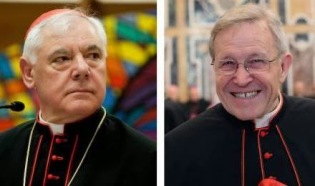
While these two men are unquestionably Catholic, they have very different visions for the life of the Church
While these two men have very different visions for the life of the Church, they are unquestionably Catholic
It was quite a remarkable week at the Catholic University of America. In what we were told was "completely coincidental," two different (and I mean different) Cardinals found their way onto campus to give lectures about the Church. On Monday, Gerhard Cardinal Müller, the prefect of the Congregation of the Doctrine of the Faith (CDF), gave a lecture to the public, and on Tuesday prayed evening prayer and gave a lecture before a private audience of seminarians. On Thursday, Walter Cardinal Kasper received a medal for "Excellence in Scholarship and Leadership in Religious Studies" from the Catholic University of America and gave a lecture entitled, "Theological Background of the Ecclesiological Ecumenical Vision of Pope Francis."
For those not up on the latest gossip--I mean news--within the Vatican regarding the Synod on the Family, this is quite a coupling of Cardinals to have speak in one week. Both men have been the center of attention of media personnel, and many have caricatured these men against one another as theological and political enemies, one being the progressive in favor of doctrinal change, the other the conservative defending the faith against heresy. While there is some truth to this, as they appear to have taken different stances on a couple of key issues, it seems to me to be a gross oversimplification of the issues and an attempt to create schism where no schism exists. These men hold different points of view regarding the life of the Church, sure, but they are also very Catholic in doing so.
Of the two, Müller's was certainly the drier of the lectures. Being the prefect of the CDF, one did not expect him to present anything revolutionary or controversial. Added to that, language was definitely a barrier, meaning that his entire lecture and even much of the question-and-answer session, was read from prewritten statements. As far as presentation goes, I have to admit, I struggled to stay awake.
At the same time, though, it was a really worthwhile experience. Attended by and geared toward seminarians alone, the whole evening was a pretty inspiring event. While the Franciscans (OFM) and the Dominicans appeared to be the only religious in attendance (ahem... Carmelites, Capuchins, TORs, Conventuals, Paulists...), there were hundreds of seminarians in attendance, all students at CUA. That was pretty amazing to see. Vocations to religious life and the priesthood are by no means where they need to be, but it's clear that there has been a small resurgence in numbers over the past five to ten years. Müller took notice of this, but seemed to indicate that quality is more important than quantity. Encouraging us to embrace the process of growth and conversion, he told us that seminary and formation were not simply, "I believe ze English term is 'hoops to jump troo.'" We must always ground ourselves in faith, and recognize our journey in the life of the Eucharistic celebration. With the mass as our foundation, seminary and formation is not the step before we get to where we're going, but rather the experience of Christ right now on our journey of faith.
As an added "bonus" to the night, Cardinal Müller shook each of our hands, took a group picture, and invited us to tour the Saint John Paul II exhibit recently opened. (More about this experience at the end.)
But as worthwhile as our evening with Cardinal Müller was, it pales in comparison to Cardinal Kasper's lecture. Let's just say that the man was candid, casual, and full of joy with the current pope. Francis, he said, is Jesuit to the core (not a Franciscan in disguise.) Unlike his predecessor who exercised faith from the standpoint of his intellect and theory, Francis' faith is rooted in experience and defined by practical measures. Distinctly South American, he exemplifies a method of theology found in the liberation theologians: see, judge, act. Unlike the liberation theologians, however, the Gospel is not primarily a message of liberation, but rather joy, and joy cannot be contained. It is God's mercy that defines the Gospel, not law. As such, social justice is not some far off ideal we seek, but rather "the minimum amount of mercy" required by all. The Gospel requires more than just the minimum, more than just "what is due." It requires mercy.
Through this lens, he described, Francis' understanding of the Church is straight out of the Second Vatican Council, even if he never mentions it. "He doesn't mention Vatican II a lot. The reason for this is not that he doesn't agree with it, it's that that he has embodied it so completely in himself." For Francis, the Church should not be like a business in which the CEO dictates the mission and the heads of each department work towards pleasing the boss, guided by strict laws and protocols; the Church is not a top-down institution with the pope as the sole source and authority of truth, dictating doctrine for everyone to follow. The Church is the people of God, the messianic people, the sensus fidei, and he wants full participation from everyone, particularly the laity. Just as the outwardly written "doctrines" are secondary to the inward gifts of the Holy Spirit through the Gospel, the Magisterium is there, not to impose burdens on the people, but to listen to and serve the people of God. When the Church becomes self-centered, failing to move to the peripheries of society and Church out of fear, the joy of the Gospel does not get communicated. (I've intended to write a post about Francis, and maybe I'll get there, but can I just go on record to say that I love this guy?)
It's here, I guess, that the reflective piece of this post begins, and the true purpose of writing comes out. Having listened to two Cardinals with very different tones this week, and having spent a lot of time in conversation about the differences between the papacies of John Paul II and Francis, (not to mention the fact that there were two people protesting outside of one of the lectures!) I cannot help but recognize that each of these men is truly Catholic in his theology and understanding of Church, even if I prefer one over another. I think Cardinal Kasper's very candid opening line of his lecture expresses what I want to say: "For some of you, the papacy of Francis is a spring of new life, a great warmth after a winter that has lasted for many years; for others of you, it is an unwelcome cold spell that has caused you to grab your coat and pray for a short winter." This is not a new phenomenon, nor does it indicate that we are headed towards schism. To have a different perspective on Church, and thus, to be disappointed with the Church's leadership at a given time, does not make someone a good or bad Catholic. As I walked around the John Paul II exhibit, I couldn't help but be inspired by the many wonderful things he did and the great man of prayer that he always was; at the same time, I couldn't help but remember that his understanding of Church and style of leadership were far from my own, and that he did a lot to undo the reforms put in place by the Second Vatican Council that really define my own theology. And that's okay.
You see, we live in a pluralistic world, and like it or not, worship in a pluralistic Church. Having now taken classes in Church history, history of theology, history of the sacraments, foundations of moral theology, and social ethics, it's clear to me that there has never been time in which everyone in the Church believed and acted the same way, even among the greatest of theologians. (Look at Saint Bonaventure and Saint Thomas Aquinas: contemporaries and doctors of the Church, they represent a Church moving in opposing directions. Look at East and West: truly faithful people that agree on every important dogmatic statement (minus one word that we added later...), both drawing their lineage all the way back to Jesus, and yet are very different in thought and practice.) While the experience of God's revelation in Christ is unchanging, the way we understand that revelation and live it out develops over time. Just because we may have different opinions about theology and Church organization does not mean that one is right and one is wrong, it simply means, as Kasper said, "The totality of God cannot fit into one human perspective." Instead of calling for Schism or name-calling among the people of faith, instead of a theology of arrogance that claims to know all that there is about the infinite, let us treat one another with humility of heart and joy for the Gospel, and do as St. Paul tells us: "Test everything; retain what is good."

Wednesday November 12 -And One Leper returned to give thanks. Today's Gospel Reading