Monday, February 8, 2016


Saturday, February 6, 2016
Lent

How Do You Feel about Lent?
Whether Lent is your favorite season or one that you'd just as soon ignore, you know that it is an important observance in the liturgical calendar. Lent is a time to focus on the deepest mysteries of our faith and try to connect more personally to those spiritual truths.
A Time of Mercy and Grace
Wednesday, February 3, 2016
Tuesday, February 2, 2016
February 2, Feast of the Presentation

|

Today is our Sister Pat's feast day. Sr. Pat chose this day because she likes the symbol of light.
Monday, February 1, 2016
Frederick Douglass February 1, 2016

Frederick Douglass (born Frederick Augustus Washington Bailey, c. February 1818[3] – February 20, 1895) was an African-American social reformer, abolitionist,orator, writer, and statesman. After escaping from slavery, he became a leader of the abolitionist movement, gaining note for his dazzling oratory[4] and incisive antislavery writings. He stood as a living counter-example to slaveholders' arguments that slaves lacked the intellectual capacity to function as independent American citizens.[5][6] Even many Northerners at the time found it hard to believe that such a great orator had once been a slave.[7]
Douglass wrote several autobiographies. He described his experiences as a slave in his 1845 autobiography, Narrative of the Life of Frederick Douglass, an American Slave, which became a bestseller, and was influential in promoting the cause of abolition, as was his second book, My Bondage and My Freedom (1855). After theCivil War, Douglass remained an active campaigner against slavery and wrote his last autobiography, Life and Times of Frederick Douglass. First published in 1881 and revised in 1892, three years before his death, it covered events during and after the Civil War. Douglass also actively supported women's suffrage, and held several public offices. Without his approval, Douglass became the first African American nominated for Vice President of the United States as the running mate and Vice Presidential nominee of Victoria Woodhull, on the Equal Rights Party ticket.[8]
Thursday, January 28, 2016
Friar Michael Reyes OFM and Sister Nelia OSC
Friar Michael Reyes OFM was ordained to the priesthood on January 16, 2016 at the Church of Saint Francis Assisi, in New York City. Friar Andrew Reitz OFM is the pastor of that Church. Bishop Roberto Gonzalez OFM consecrated Michael to the priesthood and also gave the homily at the Mass.
Today, January 28, Friar Michael said one of his first Masses in our Monastery and gave us his first blessing.
Our Sister Nelia renewed her vows today as well. So the day was very special to her and to us.
No pictures of Sister Nelia by her request.
Monday, January 25, 2016
Saturday, January 23, 2016
Friday, January 22, 2016
Pope Francis' Message for World Communications Day
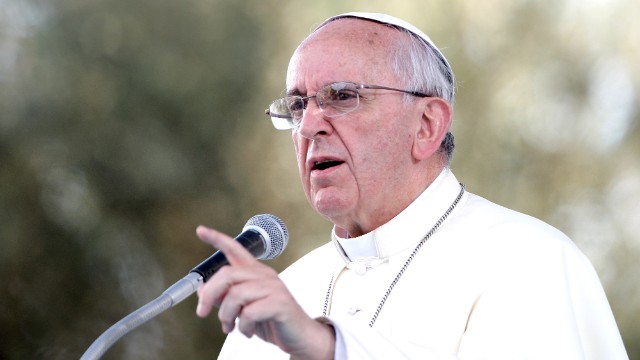
Complete text of the Pope Francis' message for the 50th World
Communications Day
2016-01-22
Communication and Mercy: A Fruitful Encounter
Dear
Brothers and Sisters,
The
Holy Year of Mercy invites all of us to reflect on the relationship between
communication and mercy. The Church, in union with Christ, the living
incarnation of the Father of Mercies, is called to practise mercy as the
distinctive trait of all that she is and does. What we say and how we say it,
our every word and gesture, ought to express God’s compassion, tenderness and
forgiveness for all. Love, by its nature, is communication; it leads to
openness and sharing. If our hearts and actions are inspired by charity, by
divine love, then our communication will be touched by God’s own power.
As
sons and daughters of God, we are called to communicate with everyone, without
exception. In a particular way, the Church’s words and actions are all meant to
convey mercy, to touch people’s hearts and to sustain them on their journey to
that fullness of life which Jesus Christ was sent by the Father to bring to
all. This means that we ourselves must be willing to accept the warmth of
Mother Church and to share that warmth with others, so that Jesus may be known
and loved. That warmth is what gives substance to the word of faith; by our
preaching and witness, it ignites the "spark” which gives them life.
Communication
has the power to build bridges, to enable encounter and inclusion, and thus to
enrich society. How beautiful it is when people select their words and actions
with care, in the effort to avoid misunderstandings, to heal wounded memories
and to build peace and harmony.
Words
can build bridges between individuals and within families, social groups and
peoples. This is possible both in the material world and the digital world. Our
words and actions should be such as to help us all escape the vicious circles
of condemnation and vengeance which continue to ensnare individuals and
nations, encouraging expressions of hatred. The words of Christians ought to be
a constant encouragement to communion and, even in those cases where they must
firmly condemn evil, they should never try to rupture relationships and communication.
For
this reason, I would like to invite all people of good will to rediscover the
power of mercy to heal wounded relationships and to restore peace and harmony
to families and communities. All of us know how many ways ancient wounds and
lingering resentments can entrap individuals and stand in the way of
communication and reconciliation. The same holds true for relationships between
peoples. In every case, mercy is able to create a new kind of speech and
dialogue. Shakespeare put it eloquently when he said: "The quality of
mercy is not strained. It droppeth as the gentle rain from heaven upon the
place beneath. It is twice blessed: it blesseth him that gives and him that
takes” (The Merchant of Venice, Act IV, Scene I).
Our
political and diplomatic language would do well to be inspired by mercy, which
never loses hope. I ask those with institutional and political responsibility,
and those charged with forming public opinion, to remain especially attentive
to the way they speak of those who think or act differently or those who may
have made mistakes. It is easy to yield to the temptation to exploit such
situations to stoke the flames of mistrust, fear and hatred. Instead, courage
is needed to guide people towards processes of reconciliation. It is precisely
such positive and creative boldness which offers real solutions to ancient
conflicts and the opportunity to build lasting peace. "Blessed are the
peacemakers, for they will be called children of God” (Mt 5:7-9)
How
I wish that our own way of communicating, as well as our service as pastors of
the Church, may never suggest a prideful and triumphant superiority over an
enemy, or demean those whom the world considers lost and easily discarded.
Mercy can help mitigate life’s troubles and offer warmth to those who have
known only the coldness of judgment. May our way of communicating help to
overcome the mindset that neatly separates sinners from the righteous. We can
and we must judge situations of sin – such as violence, corruption and exploitation
– but we may not judge individuals, since only God can see into the depths of
their hearts. It is our task to admonish those who err and to denounce the evil
and injustice of certain ways of acting, for the sake of setting victims free
and raising up those who have fallen. The Gospel of John tells us that
"the truth will make you free” (Jn 8:32). The truth is ultimately Christ
himself, whose gentle mercy is the yardstick for measuring the way we proclaim
the truth and condemn injustice. Our primary task is to uphold the truth with
love (cf. Eph 4:15). Only words spoken with love and accompanied by meekness
and mercy can touch our sinful hearts. Harsh and moralistic words and actions
risk further alienating those whom we wish to lead to conversion and freedom,
reinforcing their sense of rejection and defensiveness.
Some
feel that a vision of society rooted in mercy is hopelessly idealistic or
excessively indulgent. But let us try and recall our first experience of
relationships, within our families. Our parents loved us and valued us for who
we are more than for our abilities and achievements.
Parents
naturally want the best for their children, but that love is never dependent on
their meeting certain conditions. The family home is one place where we are
always welcome (cf. Lk 15:11-32).
I
would like to encourage everyone to see society not as a forum where strangers
compete and try to come out on top, but above all as a home or a family, where
the door is always open and where everyone feels welcome.
For
this to happen, we must first listen. Communicating means sharing, and sharing
demands listening and acceptance. Listening is much more than simply hearing.
Hearing is about receiving information, while listening is about communication,
and calls for closeness. Listening allows us to get things right, and not
simply to be passive onlookers, users or consumers. Listening also means being
able to share questions and doubts, to journey side by side, to banish all
claims to absolute power and to put our abilities and gifts at the service of
the common good.
Listening
is never easy. Many times it is easier to play deaf. Listening means paying
attention, wanting to understand, to value, to respect and to ponder what the
other person says. It involves a sort of martyrdom or self-sacrifice, as we try
to imitate Moses before the burning bush: we have to remove our sandals when
standing on the "holy ground” of our encounter with the one who speaks to
me (cf. Ex 3:5). Knowing how to listen is an immense grace, it is a gift which
we need to ask for and then make every effort to practice.
Emails,
text messages, social networks and chats can also be fully human forms of
communication. It is not technology which determines whether or not
communication is authentic, but rather the human heart and our capacity to use
wisely the means at our disposal. Social networks can facilitate relationships
and promote the good of society, but they can also lead to further polarization
and division between individuals and groups. The digital world is a public
square, a meeting-place where we can either encourage or demean one another,
engage in a meaningful discussion or unfair attacks. I pray that this Jubilee
Year, lived in mercy, "may open us to even more fervent dialogue so that
we might know and understand one another better; and that it may eliminate
every form of closed-mindedness and disrespect, and drive out every form of
violence and discrimination” (Misericordiae Vultus, 23). The internet can help
us to be better citizens. Access to digital networks entails a responsibility
for our neighbour whom we do not see but who is nonetheless real and has a
dignity which must be respected. The internet can be used wisely to build a
society which is healthy and open to sharing.
Communication,
wherever and however it takes place, has opened up broader horizons for many
people. This is a gift of God which involves a great responsibility. I like to
refer to this power of communication as "closeness”. The encounter between
communication and mercy will be fruitful to the degree that it generates a
closeness which cares, comforts, heals, accompanies and celebrates. In a
broken, fragmented and polarized world, to communicate with mercy means to help
create a healthy, free and fraternal closeness between the children of God and
all our brothers and sisters in the one human family.
From
the Vatican, 24 January 2016
|
·
·
|
Thursday, January 21, 2016
Thursday Feast of Saint Agnes and special Day for Our Sister Agnes

 |
| Sister Agnes Valimont OSC of chesterfield is celebration her feast Day today. we will have a festive dinner. |
Agnes of Rome (c. 291 – c. 304) is a virgin–martyr, venerated as a saint in the Roman Catholic Church, Eastern Orthodox Church, the Anglican Communion, and Lutheranism. She is one of seven women, who along with the Blessed Virgin, are commemorated by name in the Canon of the Mass. She is the patron saint of chastity, gardeners, girls, engaged couples, rape survivors, virgins, and the Children of Mary.
Agnes is depicted in art with a lamb, as the Latin word for "lamb", agnus, sounds like her name. The name "Agnes" is actually derived from the feminine Greek adjectivehagnē (ἁγνή) meaning "chaste, pure, sacred".
Agnes' feast day is 21 January. In pre-1970 versions of the General Roman Calendar an additional feast of the same saint is given one week later, on 28 January (see Tridentine Calendar). The 1969 revision removed this as a duplication of the 21 January feast.[1]
Subscribe to:
Posts (Atom)