Tuesday, December 16, 2014

What the Visitation Report Means for Vocations

What the Visitation Report Means for Vocations

What the Visitation Report Means for Vocations

Paul Bednarczyk | Dec 16 2014 - 3:41pm | 0 comments
Nuns listen during Vatican press conference for release of final report of Vatican-ordered investigation of U.S. communities of women religious.
The recently released Apostolic Visitation Final Report acknowledges the challenges of contemporary vocation promotion for women religious. This was also confirmed in the now landmark 2009 “Study on Recent Vocations to Religious Life,” commissioned by the National Religious Vocation Conference (NRVC) in collaboration with the Center for Applied Research in the Apostolate (CARA). The challenges of an aging, diminishing population, coupled with fewer entrants, present unique opportunities to religious congregations in their desire to attract a newer membership, who tend to be more educated, a bit older and more culturally diverse. What sometimes is forgotten is that although they are fewer in number, by the grace of God, women continue to respond to the call to religious life in the Catholic Church. In fact, it is estimated that there are 1,200 women currently in religious formation in the United States with several thousand more seriously discerning a religious vocation each year.
The findings in the Final Report are also similar to what NRVC learned in its “Women Religious Moving Forward in Hope” program, a series of four gatherings of vocation directors and major superiors from the two leadership conferences (LCWR and CMSWR). The goal of this program was to have sisters from diverse traditions, charisms and spiritualties, explore individual and common vocation efforts in response to the 2009 vocation study. Through a facilitated process of respectful dialogue, the sisters expressed a desire to define clearly their identity as women religious as different from the laity and those in other forms of consecrated life. They recognized the need for reconciliation among sisters themselves, were grateful to dialogue with women from both conferences and desired to work together for their common future. They saw the need for a revitalization of their communities and desired to work with parishes, dioceses and church leaders and minsters to expose youth and young adults to this unique form of discipleship in the church.
Thus, the Visitation report affirms in many ways what many women religious already know and what they have worked to address (admittedly, some more proactively than others).
What is truly hopeful is the Holy See’s commitment to “engage in respectful and fruitful dialogue with” women religious so as “to transform uncertainty and hesitancy into collaborative trust.” Religious sisters are an essential and formidable force in the life of the church. They have managed hospitals, schools and universities and have forged innovative, effective ministries to meet the needs of the poor with little money, but with great vision and determination. I applaud the Congregation’s acknowledgement of the structural, cultural, and financial challenges women’s religious institutes face in attracting and retaining new members. I am especially heartened by the Congregation’s very clearly stated commitment to work with Pope Francis to find expression for “feminine genius” and a role for women in “decision making in the different areas of Church life.”
During this Year of Consecrated Life, Pope Francis invites all religious to look to our future with hope. If this final report furthers the realization of honest dialogue and greater collaboration among religious and church authorities, then the future of religious life will be stronger. This will benefit not only religious institutes, but the church and the People of God as well who have always relied on the faithful service and inspiring lives and witness of our sisters. What could more hopeful than that?
Paul Bednarczyk, C.S.C., is executive director of the National Religious Vocation Conference.


    December 16- Daily Prayer


    From the Plough
    Christoph Friedrich Blumhardt
    The Sovereign Lord has given me a well-instructed tongue, to know the word that sustains the weary. He wakens me morning by morning, wakens my ear to listen like one being instructed. Isaiah 50:4, NIV
    Lord our God, we thank you for giving us the task of serving you in the name of your servant, Jesus Christ, for letting each of us have a part in carrying out your will. Keep us true to this service. We want to be faithful, always listening to you, for you open our ears and help us know your will and respond to it. Be with us in these days. Strengthen your love and compassion in all hearts. May the life of Jesus Christ gain greater and greater power in all people on earth. Amen.


    Saturday, December 13, 2014

    Third Sunday of Advent - Rejoice- December 14

    JOHN THE BAPTIST AND JESUS
    (A biblical reflection on THE THIRD SUNDAY OF ADVENT [Year B], 14 December 2014)
    Gospel Reading: John 1:6-8,19-28
    First Reading: Isaiah 61:1-2,10-11; Psalms: Luke 1:46-50,53-54; Second Reading: 1 Thessalonians 5:15-24
    john-baptist-lds-art-parson-39541-printThe Scripture Text
    There was a man sent from God, whose name was John. He came for testimony, to bear witness to the light, that all might believe through him. He was not the light, but came to bear witness to the light.
    And this is the testimony of John, when the Jews sent priests and Levites from Jerusalem to ask him, “Who are you?” He confessed, he did not deny, but confessed, “I am not the Christ.” And they asked him, “What then? Are you Elijah?” He said, “I am not.” “Are you a prophet?” And he answered, “No.” They said to him then, “Who are you?” Let us have an answer for those who sent us. What do you say about yourself?” He said, “I am the voice of one crying in the wilderness, ‘Make straight the way of the Lord,’ as the prophet Isaiah said.”
    Now they had been sent from the Pharisees. They asked him, “Then why are you baptizing, if you are neither the Christ, nor Elijah, nor the prophet?” John answered them, “I baptize with water; but among you stands One whom you do not know, even He who comes after me, the thong of whose sandal I am not worthy to untie.” This took place in Bethany beyond the Jordan, where John was baptizing. (John 1:6-8,19-28 RSV)
    How wonderful it is that from the very beginning, God has been intimately involved in human history, constantly at work to fulfil His promises to us! From generation to generation, He has raised up servants to speak His word and form His people. These women and men, each in her or his own way, reflected something of the promised Messiah, the one through whom God would abundantly pour out His Spirit. This promised one would come to bring freedom to prisoners, good news to the poor, and consolation to the brokenhearted (Isaiah 61:1-2). How God’s people must have waited and longed for the fulfillment of these words!
    KASIHILAH TUHAN ALLAHMU DST.We know that the fulfilment of all our hopes is found in the person of Jesus Christ, “the true light that enlightens everyone” (John 1:9). In Jesus’ birth, all the grace of God came to earth. In His death, He destroyed the power of sin which held us in bondage. In His ascension, He poured out the Holy Spirit on all who would believe. Now, through Jesus, everything God intended for us is within our reach. Our consciences can be cleansed; fear can be lifted; memories can be healed; bitterness and anger can be dissolved.
    As much as we have experienced the power of Jesus’ cross to transform us, there is much more that God wants to do in us, and so He asks us to come to Him each day. When we turn to Jesus, we discover that He is always ready to draw us closer to Himself and bring us into the life of the Trinity. We all have a longing in our hearts for the complete fulfillment of God’s healing and restoration, and this longing – which God placed in us – is but a reflection of our Father’s desire to shower His love upon us.
    As we approach the sacrament of reconciliation this Advent, let us ask the Holy Spirit to continue God’s work in our hearts. When we confess our sins, let us be confident that God will forgive us, heal us, and restore us. He began this work when we were baptized into Jesus’ death and resurrection. He now continues to work as we turn our hearts to Him and allow Him to cleanse and purify us more deeply.
    May the God of peace Himself sanctify you wholly … He who calls you is faithful, and He will do it” (1 Thessalonians 5:23-34).
    Prayer: Heavenly Father, our good Lord God, thank You for sending us Jesus Christ, Your only begotten Son, as the fulfilment of all our hopes. Thank You for Your healing and restoration through His death and resurrection. Amen.
    Jakarta, 12 December 2014
    A Christian Pilgrim

    Friday, December 12, 2014

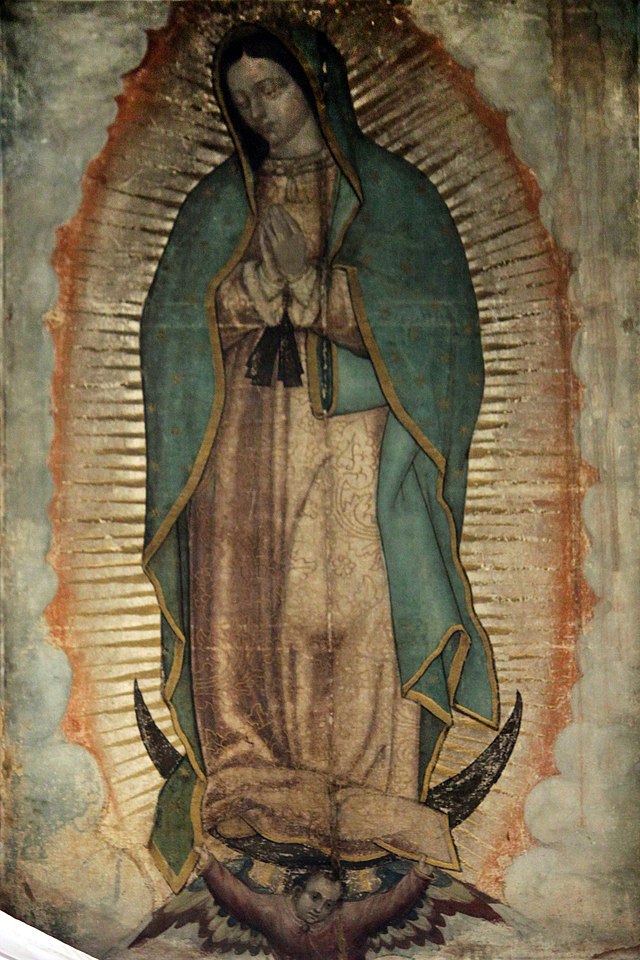
    December 12 -Feast of Our Lady of Gaudalupe

     
    Sister Nelia fixed the altar with this beautiful tapestry.
     
    May our Lady bless all the Americas especially Mexico.
     

    Wednesday, December 10, 2014

    Feast of Our Lady of Gaudalupe is December 12


    Our Lady of Guadalupe (Spanish: Nuestra Señora de Guadalupe), also known as the Virgin of Guadalupe (Spanish: Virgen de Guadalupe), is a title of the Virgin Mary associated with a celebrated pictorial image housed in the Basilica of Our Lady of Guadalupe in México City. The basilica of Our Lady of Guadalupe is the most visited Catholic site in the world, and the third-most visited sacred site in the world.[1][2]
    Official Catholic accounts state that on the morning of December 9, 1531, Juan Diego saw an apparition of a maiden at the Hill of Tepeyac, in what would become the town of Villa de Guadalupe in the suburbs of Mexico City. Speaking to him in the native Nahuatl language, the maiden asked that a church be built at that site in her honor; from her words, Juan Diego recognized the maiden as the Virgin Mary. Diego recounted the events to the Archbishop of Mexico City, Fray Juan de Zumárraga, who instructed him to return to Tepeyac Hill, and ask the "lady" for a miraculous sign to prove her identity. The first sign was the Virgin healing Juan's uncle. The Virgin told Juan Diego to gather flowers from the top of Tepeyac Hill, where he found Castilian roses, not native to Mexico, blooming in December on the normally barren hilltop. The Virgin arranged the flowers in his tilma or cloak, and when Juan Diego opened his cloak before Bishop Zumárraga on December 12, the flowers fell to the floor, and on the fabric was the image of the Virgin of Guadalupe.[3]
    The image on the tilma has become Mexico's most popular religious and cultural symbol, and has received widespread ecclesiastical and popular support. In the 19th century it became the rallying call of American-born Spaniards in New Spain, who saw the story of the apparition as legitimizing their own Mexican origin and infusing it with an almost messianic sense of mission and identity - thus also legitimizing their armed rebellion against Spain.[4][5]
    Although the former curator of the basilica Monsignor Guillermo Schulemburg, have doubted the historical existence of Juan Diego and "had sent a letter to the Vatican's Congregation for the Cause of Saints disputing whether Blessed Juan Diego ever existed and objecting to plans for canonization. [...] Father Oscar Sanchez, in charge of Juan Diego's cause, [...] said that Father Schulenberg and two other priests who signed the letter have "zero credibility .... They have no authority." [6] Juan Diego was canonized in 2002, under the name Saint Juan Diego Cuauhtlatoatzin.


    Saturday, December 6, 2014

    (A biblical reflection on THE SECOND SUNDAY OF ADVENT, 7 December 2014)

    (A biblical reflection on THE SECOND SUNDAY OF ADVENT, 7 December 2014)
    deserts
    Gospel Reading: Mark 1:1-8
    First Reading: Isaiah 40:1-5,9-11; Psalms: Psalm 85:9-14; Second Reading: 2 Peter 3:8-14
    The Scripture Text
    The beginning of the Gospel of Jesus Christ, the Son of God. As it is written in Isaiah the prophet, “Behold, I send My messenger before thy face, who prepare thy way; the voice of one crying in the wilderness: Prepare the way of the Lord, make His paths straight.” John the baptizer appeared in the wilderness, preaching a baptism of repentance for the forgiveness of sins. And there went out to him all the country of Judea, and all the people of Jerusalem; and they were baptized by him in the river Jordan, confessing their sins. Now John was clothed with camel’s hair, and had a leather girdle around his waist, and ate locusts and wild honey. And he preached, saying, “After me comes He who is mightier than I, the thong of whose sandals I am not worthy to stoop down and untie. I have baptized you with water; but He will baptize you with the Holy Spirit.” (Mark 1:1-8 RSV)
    The Good News is about Jesus Christ, the Son of God, who came into our world and released the life-giving waters of the Holy Spirit to flow within us.
    Today we read the beginning of the holy Gospel according to Mark. He will be our guide to the memory of Jesus Christ for most of the Sundays of the coming year. Hence we can call it the year of Mark. Mark seems to have been the earliest of the four evangelists. He pioneered the work of setting to paper a comprehensive composition of the Christian community’s story of how God met mankind in the life of Jesus Christ.
    Mark begins with a glorious statement of his intention to tell “the Good News about Jesus Christ, the Son of God” (Mark 1:1). Our older translations used the term Gospel for the Good News. Gospel is the shortened form of god-spel which in Old English meant good news. This is an attempt to translate the Greek word which Mark used, evangelion. We have to imagine a world without TV, radio or newspapers. The town-crier or the herald of the king would proclaim the great events to the people. When the event to be announced was one calling for joy and celebration it was called an evangelion. It might be news of a victory in battle or perhaps a birth in the royal family.
    YOHANES PEMBAPTIS - 3The Christian writers, Paul and Mark especially, took over this word evangelion and invested it with a divine depth of meaning. As the herald of the great king, Mark begins his story of Jesus Christ with the proclamation that this was an evangelion. His use of the word has remained until our own day whenever we refer to the Gospel or to the Good News.
    After his initial proclamation Mark prefaces his story by relating how John the Baptist went before Jesus, as a messenger preparing the way and as a voice calling from the wilderness. Marks picks up the popular expectation that the prophet of olden times, Elijah, would come back to prepare the people for the Messiah, John appears in the primitive, non-conformist style of Elijah who had been described as “a man wearing a hair cloak and a leather loincloth” (2 Kings 1:8).
    Mark differs from the evangelist Matthew and Luke in that he does not have the Baptist preaching a coming judgment as the urgent motive for repentance. In Mark’s gospel repentance wears a happy face.
    Today’s liturgy links this gospel with a great message of consolation in the first reading. “Console my people ... Jerusalem’s time of services is ended ... her sin is atoned for.” Isaiah continues: “Sion, here is your God.” And that is the Good News which Mark sees the Baptist preparing for ... the coming of God.
    The Good News of John the Baptist is twofold: it concerns the acknowledgment by people of their sins; and it offers the hope that someone is coming, someone powerful, someone who will release the life-giving waters of God’s Spirit upon the earth. Later on the preaching of Jesus will carry on this twofold message: repent and believe.
    It may seem strange to suggest that the Good News is firstly about sin. But while everybody admits that there is a great deal wrong with our world, we have largely forgotten the name of the disease. When a physician diagnoses what is wrong with a patient then the anxiety of all unknown possibilities is removed. The name of society’s disease is sin. John the Baptist enabled people to accept this diagnosis and led them to the waters of renewal. Here the energy to repent comes, not so much from the fear of judgment, but from the approaching footfalls of the Messiah.
    The work of John the Baptist was not to be an end in itself. He came in the style of Elijah to prepare the way for the Messiah. And so, John’s function was to hand over to the One with God’s power and worthiness, the One invested with the Holy Spirit.
    This Advent, repentance comes as a message of consolations and wears a happy face. It is Good News when we acknowledge truthfully our personal responsibility for sin and place our hope in the divine power of the Holy Spirit, which Jesus released for our forgiveness and healing. The Good News began in the diagnosis of our pain, sin; and in recognizing the healing power that God sends us, the Holy Spirit.
    Short Prayer: Heavenly Father, we thank You for sending John the Baptist to prepare the way for the Messiah, Your only begotten Son, Jesus Christ, who came to the world for our eternal salvation. Amen.
    Main source: Fr. Silvester O’Flynn OFMCap., The Good News of Mark’s Year, Dublin, Ireland: The Columbia Press/Cathedral Books, 1990 (reprinted 1993), pages 10-12.
    Jakarta, 4 December 2014
    A Christian Pilgrim

    Thursday, December 4, 2014

    Advent Day 4- Reflection


    By G.K. Chesterton
     
    Good News; but if you ask me what it is, I know not. 
     It is a track of feet in the snow,
    it is a lantern showing a path,
     it is a door set open.


    Sunday, November 30, 2014

    Sunday Advent Reflection

     
    This first Advent Sunday we reflect on the coming of Christ in our world and on His second coming at the end of our own lives and at the end time.
    So Advent is God coming to us and our coming to Him.
    I sit in the chapel looking out toward White Pine Road and imagine in my mind two groups of people marching
    toward each other on the road.
    One group is Christ and all our beloved dead who already made it to the other side and our group, the Church, going toward Christ  and  His group.
    Along the way we we get distracted with events, parties, sports, shopping and leave the road for a time.
    We are called back this Advent to get serious about the journey.
    What doesn't help us,  give it away, for in the end we will have to give it all away.  But we give it away only  for the great prize - peace and final bliss forever.
    Let us pray for each other this Advent. 

    Advent Day 1 - Our Tainted Offering


     By Father Robert Baron


    Advent Day 1 - Our Tainted Offering

    We all know that Lent is a penitential season, a time when Christians get in touch with their sins. But Advent has a penitential dimension, too. It is the season in which we prepare for the coming of the Savior, and we don't need a Savior unless we're deeply convinced there is something to be saved from.

    Our first reading at Mass today, from the end of the book of the prophet Isaiah, affirms this with a whole series of images describing our sinful condition.

    For example, we hear this wonderful and terrible line: "All our good deeds are like polluted rags; we have all withered like leaves, and our guilt carries us away like the wind."

    When we have become deeply aware of our sin, we know that we can cling to nothing in ourselves, that everything we offer is, to some degree, tainted and impure. We can't show our cultural, professional, and personal accomplishments to God as though they are enough to save us.

    But the moment we realize that fact, we move into the Advent spirit, desperately craving a Savior. We become ready for the last image from today's reading: "Yet, O Lord, you are our father; we are the clay and you are the potter: we are all the work of your hands."

    Today, let us prepare ourselves for the potter to come.

    Saturday, November 29, 2014

    1st Sunday in Advent

    WATCH AND PRAY
    (A biblical reflection on THE FIRST SUNDAY OF ADVENT [Year B], 30 November 2014)
    Gospel Reading: Mark 13:33-37
    First Reading: Isaiah 63:16-17,19;64:1,3-8; Psalms: Psalm 80:2-3,15-16,18-19; Second Reading: 1 Corinthians 1:3-9
    KESIAPSIAGAAN - LUK 12 35-40The Scripture Text
    “Take heed, watch and pray; for you do not know when the time will come. It is like a man going on a journey, when he leaves home and puts his servants in charge, each with his work, and commands the doorkeeper to be on the watch. Watch therefore – for you do not know when the master of the house will come, in the evening, or at midnight, or at cockcrow, or in the morning – lest he come suddenly and find you asleep. And what I say to you I say to all: Watch.” (Mark 13:33-37 RSV)
    Once upon a time, God, the infinite, eternal and all powerful One, came down to meet us on the dusty roads of human life. In the flesh of Jesus Christ, God walked with us through our light and darkness, our joys and sorrows, our solitude and relationships. Scripture writers called it the “fullness of time”. Things would never be the same again.
    In Jesus Christ, God spoke to us in the human language that we can understand. His life warmly portrays God’s love and concern for us. And yet the story is not complete. The journey stretches on until we fully share in Christ’s glorification. That will be at the completion of life’s journey. For the moment we are a people on the way.
    Advent is a time of waiting and watching. It is a very special time for Christians. It opens the Church’s year by picking up the theme of our journey towards Christ who is coming back to meet us. We are not like wandering nomads who have no sure purpose or definite direction. We have the pilgrim’s destiny with God. We travel forward on a road of unknown length until Christ will come again.
    pppas0594The focus of the first Sunday of Advent is on the Second Coming of Christ. The parable of the doorkeeper speaks of the master who will come back to the servants. The message for the servants is twofold: “Be on your guard and stay awake” ...... watch and pray.
    One task of the doorkeeper’s employment is to keep out unwanted visitors and intruders. Here the parable is a moral warning not to open up our doors to the ways of sin. Each passing day we are to watch with the vigilant eye of the sentry to prevent any intrusions of the enemy.
    The unexamined life is a city with no sentries on its walls. Anybody who is serious about living a spiritual life is advised to undertake a daily reflection on our situation. This means more than counting up the number of our faults. It involves an honesty about what motivates us in the things we do.
    We are sometimes surprised when we recognize that some exemplary deeds are done out of very subtle, selfish motivation. We may be doing the right things only to be praised or at least recognized as virtuous, to impress others, or as part of a self-seeking bargain with God. In daily reflection we guard against the intrusions of selfishness in our motivation.
    The second task to the doorkeeper is to open up promptly to all who have the right to enter. Applied to the spiritual life, this means a spirit of prayerfulness or sensitivity to God. The sensitive soul is awake with all the longing of the lover for the approaching footsteps of the beloved. But what is He line, this God-who-comes? In today’s first reading Isaiah uses three very appealing names for God ... our Father, our Redeemer and the potter.
    pppas0250God is the Father who has created us with the potential to share in the divine life. God is the Redeemer who continues to pay the price of liberating us from slavery to incomplete forms of life. He offers us life to the full. And God is the potter who is ever crafting our lives anew. The present clay may be messy and, in our view, without meaningful form or beauty. But the divine craftsman can mould and fashion an amazing masterpiece in the twinkling of an eye.
    The God who is coming back the road to meet us wants to lift us up as His children, wants to liberate us and fashion us anew.
    Do not think of the Second Coming as so distant and unknown as to be irrelevant to the hurly-burly of today’s living. If we are spiritually vigilant and alert then the future will draw us forward towards God. Our hope will energize us by supporting us when we are weak and encouraging us to persevere.
    Prayer: Lord Jesus, we believe that our lives are on a journey towards our heavenly Father who is reaching back to us this day and every day. So, we will be on our guard lest the ways of sin enslave our thoughts. We will also watch in prayer, be vigilant and alert to the daily visitations of the Holy Spirit to our souls. Praised be the name of the Holy Trinity, Father, Son, and the Holy Spirit. Amen.
    Jakarta, 27 November 2014
    A Christian Pilgrim