Monday, October 23, 2017

Monday October 23, 2017

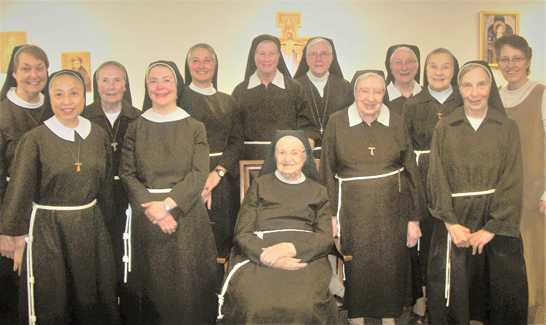
    Our latest picture of our community.
Back row Left to right Sisters Frances, Patricia, Karen, Barbara, Mary Frances, Etta, Miriam and Kathi(postulant)
First row, Left to right Sisters Nelia, Donna, Natalie (seated), Agnes and Florence.

Friday, October 6, 2017

Sister Natalie's 100th Birthday October 6th


We all had a wonderful time. Sister Barbara cooked the meal. with sister Frances and presents were opened and viewed.
all had a great time.

Thursday, October 5, 2017

Feast of Saint Francis October 4th

New post on A CHRISTIAN PILGRIMAGE

SAINT FRANCIS OF ASSISI – Memoria: 4 October

by achristianpilgrim
Saint Francis of Assisi is a complex and a multi-faceted figure. The more one seeks to understand the secret of his greatness, the more do new and unforeseen elements emerge which expand his personality and the manifestation of his deep spirituality.
The Saint of Assisi, according to the evaluation of more objective historians, is a colossus; just as Dante Alighieri, Giotto, Leonardo da Vinci, Michelangelo Buonarroti were in their fields. The human side of his person is no less surprising than his spiritual and mystical side, because Francis the man, with his gifts and qualities, immediately reminds us of the saint of love, of poverty, of peace, of poetry, of fraternity, of the perfect following of Jesus Christ. In him the union of human with the supernatural create such a blend that he is seen always and everywhere immersed in an atmosphere of sweet and intimate converse with God.
Saint Francis had a personality gifted by God. But he was also a person who knew how to follow all he interior inspirations of the Holy Spirit and the promptings of divine grace. In him one must note continually this joyous correspondence, this harmony, this equilibrium, founded in faith, animated by charity, and sustained by hope. The religious and scriptural data became for him the constant norm and rule of life, of things believed, loved, and lived in God and for God. God was truly "his all".
All this was experienced by his first companions. He appeared in their eyes as the perfect imitator of Jesus Christ, as an exceptional creature, as a living miracle, as a kind of mystery. The traces of similarity with the poor and obedient Christ were so obvious in him that it seemed possible to say that in no other man did the living image of the Redeemer shine forth as it did in Francis, so that they who came to know him or were familiar with him saluted him as another Christ. As such, in the judgment of Pope Pius XI, he will remain for future generations. [Adapted from Lombardi, OFM, INTRODUCTION TO THE STUDY OF FRANCISCANISM, page 1]
Prayer: Heavenly Father, You made Saint Francis of Assisi Christ-like in his poverty and humility. Help us so to walk in his ways that, with joy and love, we may follow Christ Your Son, and be united to You. We pray this in the most precious name of our Lord Jesus Christ, Your Son, who lives and reigns with You and the Holy Spirit, God, for ever and ever. Amen.
Jakarta, 4 October 2017
A Christian Pilgrim
achristianpilgrim | October 4, 2017 at 1:49 am | Tags: SAINT FRANCIS OF ASSISI | Categories: READ & PRAY, SAINTS WE LOVE | URL: http://wp.me/p1055h-3WO

Thursday, September 14, 2017

Thursday September 14- Feast of the Exaltation of the Cross


Today we celebrate the exaltation of the Cross.
The Church is fond of comparing the Cross to a tree, especially the tree of knowledge in paradise. In support of this we may first of all cite the words of the Preface for Mass: "It was Your will that from the wood of the Cross our salvation should go forth.  From a tree came death, from a tree also should come forth life.  He who triumphed on a tree (i.e., the devil) should also be defeated on a tree. "

There are passages in which the liturgy gives evidence that the Sign of the Cross has sacramental efficacy. the sign of the Cross puts the devil to flight.
from  The Church's Year of Grace by Dr. Pius Parsch

Friday, September 8, 2017

The White Pine - a Symbol of Peace


Sister Patrice Klausing who is a counselor at Alvernia  University in Reading , Pennsylvania  spent a week in Retreat here at the Monastery. While meditating on our surroundings ,Sister Patrice did some research on the tree the White Pine  and  shared it with us.  
It is very moving to think that the Native Americans looked on the White Pine as a sign of Peace.

We are grateful to her for sharing this  article  with us.

by Sister Patrice Klausing OSF 

THE STORY OF THE WHITE PINE 
Someone once described “coincidence” as God choosing to work a miracle and remaining anonymous. I also see it as the Holy Spirit directing discerning hearts and then waiting to reveal the full meaning at another time. Such, I think, is the story of how you came to live on White Pine Road. 
The Native Americans of the Iroquois and Algonquin tribes lived, among other places, along the shores and in the woodlands of what is now considered the Eastern half of the United States. An Iroquois man named Dekanawidah began to talk about the concept of peace and for this, he was completely misunderstood and isolated in a culture where war was a way of life. However, he persisted, and in time his people began to embrace the idea that peace had value. Dekanawidah chose the white pine as the symbol of peace, thus making the tree “The Tree of Peace.”  
The tree had four symbolic roots, The Great White Roots of peace extending north, south, east, and west. It also encompassed Dekanawidah's three aspects of peace: • The Good Word, which is righteousness in action, bringing justice for all; • Health, which is a sound mind in a sound body, bringing peace on Earth; • Power, which is the establishment of civil authority, bringing with it the increase in spiritual power in keeping with the will of the Master of Life. 
Eventually, the Algonquin tribes, which include both the Lenni Lenape and the Delaware who were both native to New Jersey and to this place, adopted the white pine as their peace symbol. I first learned of this when Bari, a Native American woman with a PhD in ethnobotany (the study of how native peoples used all the green, growing things in their environment) was leading a group of us on a tour of our Provincial House and Retreat Center grounds in Connecticut. When she came to the stand of white pines outside our chapel, she asked us to be silent and she knelt on the ground. She then told us that White Pines were sacred; that they were the tallest tree in the eastern half of the United States; that some white pines grow in “Cathedral” formations; and that they were the only place where Algonquins could bury weapons of war. After a tribal war or skirmish, the peace treaty was sealed by literally burying the battle weapons under a white pine tree. Sometimes, they even dug up the tree, placed the weapons in the hole and then replanted the tree directly over the weapons so that the tools of war were literally transformed into symbols of peace. I cannot help but remember the words of Scripture:  “They will beat their swords into plowshares” (Isaiah 2: 4). 
So, no, I don't think that it's an accident or some random happenstance  that you, the daughters and sisters of Clare of Assisi, a woman who created peace in her own day, are now living on a road called “White Pine,” one of the earliest symbols of peace in this land. • Given to the Poor Clares of Chesterfield, New Jersey, whose Monastery is adjacent to a pine tree farm, on September 8, 2017. • Much of this information came from Bari, the woman mentioned above. Details were fleshed out by Googling “white pine symbol of peace” and using information found on Wikipedia that was confirmed by several other highly reliable sources. • “Dekanawidah” is often spelled “Deganawidah.”