Thursday, June 28, 2012

Some Thoughts on Contemplative Life in the Monastery

Clara_renuncia_al_mundo

1212-2012
800th Anniversary of the Beginning of the Poor Clare Life
More Thoughts on Contemplation  from Breakthrough
Meister Eckhart's Creation
by Matthew Fox

Creation centered spirituality, the most Jewish, the most biblical ,the
most contemplative and Franciscan has been lost in the West, so says Fox.
Meister Eckhart quotes:
  • Every creature is a word of God

  • When I preach, I try to speak of letting go and that we should become unwed from ourselves.

  • Everything which is past, everything which is present, and everything which is future God creates in the soul, in the innermost soul.

  • Life is blessing and blessing is life
Creatures are an echo of the Divine.
  • Announce the Word, pronounce the Word, produce it, give birth to the Word.
_____________________________________________

Someone gave us a book by Dianne Aprile, Making A Heart For God: A Week  Inside a Catholic Monastery
Aprile spent sometime with the Monks  at the Trappist Abbey of Gethsemani, Kentucky and some of the quotes below are from her book, which we found so true to our own Poor Clare Contemplative Life.
"In the night of our own technological barbarism, monks must be as trees which exist silently in the dark and by their vital presence purify the air."  Bother Patrick Hart OCSO
"In the process of striving for union with God through solitude, silence, and Christian faith, the Catholic monk(or nun) reaches out to the world in all its diversity and extends an embrace of peace." Dianne Aprile
To us, living in the world of turmoil this is the essence of our life especially as Franciscans , "to extend an embrace of peace." As Francis said in a prayer attributed to him, "Lord, make me an instrument of your peace."
Even as we do that we will ruffle feathers but we will not be rebels in the sense of any aggressive attack.  We will be like the mighty oaks holding  our vigil in prayer.
Aprile quotes Thich Nhan Hanh who advocates a half smile as our greeting to the world upon awaking up the morning."
"A smile", he wrote confirms that you are in complete mindfulness."
If one is smiling one can not be hostile to others or to creation, especially to dogs, says me.
Like all Contemplative communities the monks and nuns of today respect and appreciate, the power of silence, solitude and simplicity and work and pray together for the world.

Further thoughts:

When you enter a contemplative (cloister) Community it is like entering into the wilderness of the desert.

One movie that speaks to this might be Hidalgo, the true story of Frank Hopkins. Hopkins lived around the time of Buffalo Bill and worked for him.

The story is, in a nutshell: Hopkins runs a race in the Arabian Desert with his wild mustang.  What Hopkins learns in the desert is to accept himself for who he is, half white and half Indian. 
In the end Hopkins uses  the money that he won to buy all the wild mustangs from the government who's intention was  to slaughter them.  The most touching part of the movie was when Hopkins  lets the wild mustangs out of the corral to run free and his own horse
makes a neighing sound and Hopkins turns, takes off the saddle of
his horse and lets the horse run with the other wild mustangs. It is a complete surrender for Hopkins in which he  lets himself and the horse be who they  truly are.

This is what the desert teaches us but first comes the surrender of everything nothing less their ourselves, and in the process we will find union with God.
And what is union with God:  Love God with all your heart and all your soul and your neighbor as yourself.  Easy? NO.
" Remove the bogus: reveal the authentic", as Brother Luke Armour of Gethsemene says.

Nothing is expected of the monk or nun except, "to be." That sounds easy until you try to do it.  Amen.
Posted bySister Florence Vales OSC

Thursday, June 7, 2012

Corpus Christi Sunday June 10th


    This mosaic is found in the Church of the Loaves and Fishes at Tabgha in the Holy Land. It reminds us  of Jesus' feeding five thousand with just a few loaves and fishes.   The story found in the Gospels is a shadow of the future institution of the Eucharist.
    The Eucharist is the center of all Christian life. for in the Eucharist Jesus Christ gives Himself to us, and we lay hold of Him.  The Eucharist is not merely a symbol and ceremony:  It is truly the sacrament in which, most of all we receive the body of Jesus Christ, true God and true Man. Our Faith tells us that this is our reality.

    St. Thomas Aquinas' Hymn is posted below: 
    It is one of the most profound explanations of the Sacrament of the Eucharist in a small kernel.

    The Sequence
    Zion, praise your Savior. Praise your Savior. Praise your leader and shepherd in hymns and canticles. Praise him as much as you can, for he is beyond all praising and you will never be able to praise him as he merits.

    But today a theme worthy of particular praise is put before us -- the living and life-giving bread that, without any doubt, was given to the Twelve at table during the holy supper.

    Therefore let our praise be full and resounding and our soul's rejoicing full of delight and beauty, for this is the festival day to commemorate the first institution of this table.

    At this table of the new King, the new law's new Pasch puts an end to the old Pasch. The new displaces the old, the reality the shadow and light the darkness. Christ wanted what he did at the supper to be repeated in his memory.

    And so we, in accordance with his holy directions, consecrate bread and wine to be salvation's Victim. Christ's followers know by faith that bread is changed into his flesh and wine into his blood.

    Man cannot understand this, cannot perceive it; but a lively faith affirms that the change, which is outside the natural course of things, takes place. Under the different species, which are now signs only and not their own reality, there lie hid wonderful realities. His body is our food, his blood our drink.

    And yet Christ remains entire under each species. The communicant receives the complete Christ -- uncut, unbroken and undivided. Whether one receive or a thousand, the one receives as much as the thousand. Nor is Christ diminished by being received.

    The good and the wicked alike receive him, but with the unlike destiny of life or death. To the wicked it is death, but life to the good. See how different is the result, though each receives the same.

    Last of all, if the sacrament is broken, have no doubt. Remember there is as much in a fragment as in an unbroken host. There is no division of the reality, but only a breaking of the sign; nor does the breaking diminish the condition or size of the One hidden under the sign.

    Behold, the bread of angels is become the pilgrim's food; truly it is bread for the sons, and is not to be cast to dogs. It was prefigured in type when Isaac was brought as an offering, when a lamb was appointed for the Pasch and when manna was given to the Jews of old.

    Jesus, good shepherd and true bread, have mercy on us; feed us and guard us. Grant that we find happiness in the land of the living. You know all things, can do all things, and feed us here on earth. Make us your guests in heaven, co-heirs with you and companions of heaven's citizens. Amen. Alleluia. 
    Posted by Sister Florence Vales OSC

Monday, June 4, 2012

Eileen Flanagan Gives us a Workshop on St. Clare


This year is the 800th Anniversary of Clare's becoming the first Franciscan Woman 1212-2012.
Eileen presented to us the Tradition of the Order of San Damiano as Idol and Clare was the model.
An idol claims to be the embodiment of that which it represents but it directs us to itself rather than beyond itself.  


Tradition of the Poor Sisters of Assisi as Icon.
An Icon  is an authentic image that is what it represents;  it bids us to look at it, but also through it and beyond it, to the living reality of which it is an embodiment. 


Tradition of the Order of St. Clare as Token


A Token points us beyond itself but it is an altogether accidental representation that does  not embody what it represents.


We were all nourished by the talks and find it enriching our study of St. Clare of Assisi and our roots.

Wednesday, May 9, 2012

Six Friars and Friar Ray Frias Visit the Monastery


Six of the Friars to visit us from Germany were: from left to right:
Friars Christophorus OFM Cap., Bernard OP, Tomas, OFM Cap.Ulrich, OP Toma, OP and student Korbinian,  The one in friar habit is Friar Ray Frias, OFM Cap.

The initials after the names means OFM Cap Order of Friars Minors, a Franciscan Branch, and OP means Order of Preachers , a Dominican Branch..

The Friars from Germany teach in University in Germany and are doing research on Secularization of society
and its effect on Religious life and of the Church.

Friar Ray brought them to our monastery so that they would understand where the contemplative life fit into this scheme of things.  The Sisters found the exchange very stimulating.


Friday, May 4, 2012

Clare and the Contemplative Life


Part From the Cloud of Unknowing
There are two kinds of Christian living. One is a life of activity.  The other is the contemplative life.  These two lives are united.  It is impossible to live the one without having some of the other.


The active life begins and ends right here.  The contemplative life begins here and continues into eternity.


For Clare she began her contemplative life on Palm Sunday 1212, 800 years ago, and it is still going on for Clare in eternity.


 The Poor Clares throughout the world continue this heritage by living a contemplative life , intent on only one thing,  that which will be continued in eternity.  


The active part of the Poor Clare life is interceding for all people through our life of prayer.


We pray daily for you and for the whole world.


Thursday, May 3, 2012

A Garden is a thing of Beauty


From a Rabbi :Steven Rubenstein.


A Reflection on Meditation of The Bible and of Gardening.


We have much to grow on in the coming year as we examine both the Torah and ourselves. I ask you to join me in a year of exploration, by sowing seeds that are a part of who we are and by reaping the fruits of our labors.
Anyone who has ever planted a vegetable garden or a flower bed knows that it takes work. Some of us have more luck than others. Perhaps it’s because of more knowledge about how to prepare the ground before planting the seeds. Perhaps it’s a matter of being more attentive to watering than those of us who trust that God will provide the proper amount of rain at the right time. Sometimes we have to take matters into our own hands if we are to fulfill our roles as God’s partner in this endeavor.


What is true about the gardens at our homes can be related to the seeds of faith that we plant in our hearts and souls. I recently read an aggadah (legend) related to what happened on Mount Sinai when we waited for Moses to return with a message from the Divine Spirit of Creation. During those three days of anticipation, the entire mountain burst forth with flowers and grass. Although it was spring­time, let us not forget that we were in a relatively barren wilderness. In some Sephardic congregations, the Torah scrolls are adorned with roses in recognition of the sweet and aromatic qualities of this ancient text. In other parts of rabbinic literature, Israel is likened to God’s private and protected orchard.
The three days of waiting are significant. On the Third Day of Creation, God established all grass and fruit-bearing trees. Just as fruit is essential for physical life, the Torah is crucial to spiritual life, as we are reminded each time we return the sacred scrolls to the ark: Eitz chayyim hee—It is a tree of life to all who take hold of it.
When I attended CAJE, a convention for Jewish educa­tors, several summers ago, I met a person who was deeply passionate about environmental issues and how they related to the spiritual nature of Jewish practice. During a hike into the mountains of Boulder, Colorado, he shared with us the following blessing from the weekday morning service that pays tribute to God as Creator:


How wonderful are Your works, Adonai, With wisdom you fashioned them all. The earth abounds in Your creations …


Please join me in another year of exploration into the Torah and the many seeds that God plants into our hearts, our minds, and our souls. It may not be an easy task for any of us to look at ourselves in this way. But let us not lose sight of the wisdom that comes from the Book of Psalms but is a part of our daily practice of giving thanks to God after each meal. We rejoice in the great things that God has done in the same way that streams revive the desert each spring.
May we all find our share of happiness in our lives, growing in our understanding of ourselves, others, the world in which we live, and in God.

Wednesday, April 25, 2012

Morning Poem by Mary Oliver and pictures of Spring


Morning Poem
Every morning
the world
is created.
Under the orange

sticks of the sun
the heaped
ashes of the night
turn into leaves again

and fasten themselves to the high branches ---
and the ponds appear
like black cloth
on which are painted islands
of summer lilies.
If it is your nature
to be happy
you will swim away along the soft trails

for hours, your imagination
alighting everywhere.
And if your spirit
carries within it 


the thorn
that is heavier than lead ---
if it's all you can do
to keep on trudging ---

there is still
somewhere deep within you
a beast shouting that the earth
is exactly what it wanted ---
each pond with its blazing lilies
is a prayer heard and answered
lavishly,
every morning,

whether or not
you have ever dared to be happy,
whether or not
you have ever dared to pray.
from Dream Work (1986) by Mary Oliver

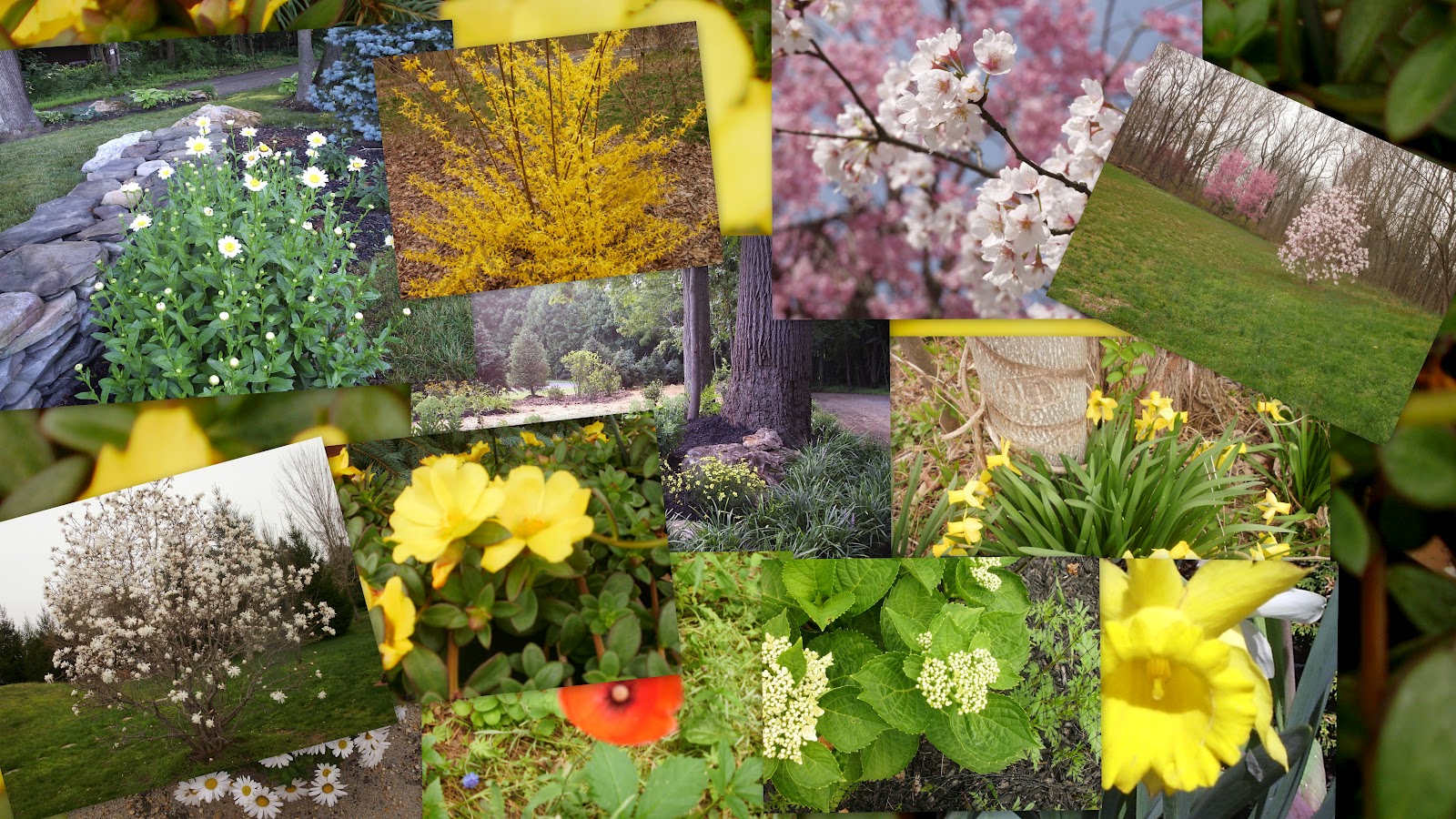
The Beauty of Nature Abounds in our Monastery Yard.
Praise to our Creator for all His Gifts.

© Mary Oliver