Sister Patrice Klausing who is a counselor at Alvernia University in Reading , Pennsylvania spent a week in Retreat here at the Monastery. While meditating on our surroundings ,Sister Patrice did some research on the tree the White Pine and shared it with us.
It is very moving to think that the Native Americans looked on the White Pine as a sign of Peace.
We are grateful to her for sharing this article with us.
by Sister Patrice Klausing OSF
THE STORY OF THE WHITE PINE
Someone once described “coincidence” as God choosing to work a miracle and remaining anonymous. I also see it as the Holy Spirit directing discerning hearts and then waiting to reveal the full meaning at another time. Such, I think, is the story of how you came to live on White Pine Road.
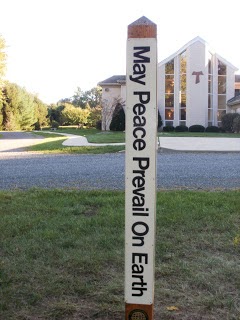
The Native Americans of the Iroquois and Algonquin tribes lived, among other places, along the shores and in the woodlands of what is now considered the Eastern half of the United States. An Iroquois man named Dekanawidah began to talk about the concept of peace and for this, he was completely misunderstood and isolated in a culture where war was a way of life. However, he persisted, and in time his people began to embrace the idea that peace had value. Dekanawidah chose the white pine as the symbol of peace, thus making the tree “The Tree of Peace.”
The tree had four symbolic roots, The Great White Roots of peace extending north, south, east, and west. It also encompassed Dekanawidah's three aspects of peace: • The Good Word, which is righteousness in action, bringing justice for all; • Health, which is a sound mind in a sound body, bringing peace on Earth; • Power, which is the establishment of civil authority, bringing with it the increase in spiritual power in keeping with the will of the Master of Life.
Eventually, the Algonquin tribes, which include both the Lenni Lenape and the Delaware who were both native to New Jersey and to this place, adopted the white pine as their peace symbol. I first learned of this when Bari, a Native American woman with a PhD in ethnobotany (the study of how native peoples used all the green, growing things in their environment) was leading a group of us on a tour of our Provincial House and Retreat Center grounds in Connecticut. When she came to the stand of white pines outside our chapel, she asked us to be silent and she knelt on the ground. She then told us that White Pines were sacred; that they were the tallest tree in the eastern half of the United States; that some white pines grow in “Cathedral” formations; and that they were the only place where Algonquins could bury weapons of war. After a tribal war or skirmish, the peace treaty was sealed by literally burying the battle weapons under a white pine tree. Sometimes, they even dug up the tree, placed the weapons in the hole and then replanted the tree directly over the weapons so that the tools of war were literally transformed into symbols of peace. I cannot help but remember the words of Scripture: “They will beat their swords into plowshares” (Isaiah 2: 4).
So, no, I don't think that it's an accident or some random happenstance that you, the daughters and sisters of Clare of Assisi, a woman who created peace in her own day, are now living on a road called “White Pine,” one of the earliest symbols of peace in this land. • Given to the Poor Clares of Chesterfield, New Jersey, whose Monastery is adjacent to a pine tree farm, on September 8, 2017. • Much of this information came from Bari, the woman mentioned above. Details were fleshed out by Googling “white pine symbol of peace” and using information found on Wikipedia that was confirmed by several other highly reliable sources. • “Dekanawidah” is often spelled “Deganawidah.”




 The words of Saint Clare as she was dying are beautiful words that we can all use as we approach our death which we do daily.


